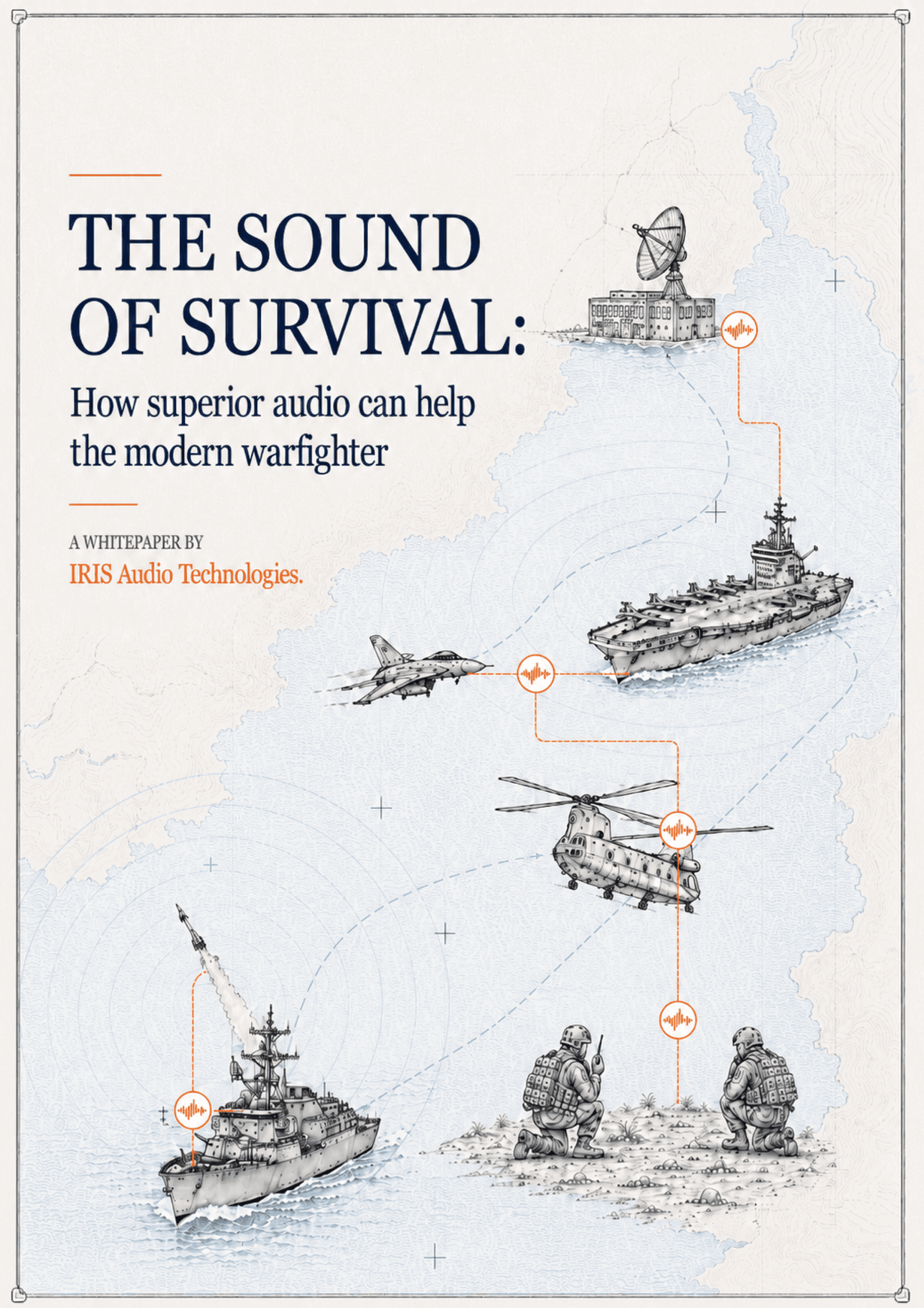
The sound of survival
How superior audio can help the modern warfighter
Defence spends billions on the platforms that keep us safe, but far less attention goes on how the people inside them hear each other. This paper looks at what noise in the comms stream costs on land, in the air and at sea – and what can be done about it today.
In this whitepaper, you’ll learn:
- Why protecting hearing isn’t the same as protecting understanding – and the trade-off it forces on situational awareness
- How degraded audio slows reaction times, multiplies cognitive load and erodes lethality, survivability and safety
- How AI noise removal on a sub-gram chip can retrofit into existing radios and headsets with no retraining
- Three policy recommendations for making superior audio a standard, like encryption and frequency hopping before it
Get your free copy
Fill in your details and we'll email you the PDF straight away.
KEY FINDINGS
Noise doesn’t just add up. It multiplies.
Poor signals and complex tasks compound each other. The research drawn together in the paper shows what that costs in the real world.
25s
slower response to a missile attack at sea, shrinking the interception window
20%
drop in a ship’s crew situational awareness
5%
of messages carry incorrect or inaccurate information into command and control
103%
increase in the time taken to defeat a target on land
27%
of pilots report near-crash incidents linked to poor audio from air traffic control
Inside the paper
Land, air and sea – one problem
From the cockpit of an F-16 to the loadramp of a Chinook and the combat information centre of a destroyer, the paper maps how noise degrades communication across every domain.
Hearing vs understanding
Hearing protection, platform noise and the limits of active noise cancelling.
Land
The two types of noise soldiers face, and how size, weight and power shape the kit they carry.
Air
The cockpit communication environment and a model of pilot cognitive load.
Sea
How reduced intelligibility slows reaction times in naval combat.
Across echelons
A Red Sea scenario tracing communication failures from land forces to maritime air defence.
Policy recommendations
Managing programme risk, setting new standards and preparing for what AI audio enables next.
IRIS VIPER
AI noise removal, built for the edge
Proven with Formula 1 teams, contact centres and banks, IRIS’s AI models are now small enough to run on a chip inside push-to-talk devices – removing noise from the comms stream before it reaches the listener and repairing clipped speech.
95%+
speech intelligibility, whatever the conditions around the speaker
27%
fewer read-back requests, so messages are understood first time
Under 1 gram
chip weight, with the first push-to-talk unit at just 300 g
100+ hours
on a single AAA battery; backwards compatible, with no maintenance or training
IRIS was selected to power our voice isolation solution for emergency services communications following a detailed RFP process amongst five potential suppliers. IRIS rated as the most performant technology, in addition to being the most scalable approach for deployment.
Product Director, Motorola
Make IRIS part of the mission
Get the whitepaper
Fill out a short form and we'll send the full research straight to your inbox.
Our podcast
Our team discussed the vital nature of accurate voice communication in Defence.
Speak to our team
Talk to our team about trialling IRIS VIPER in your radios and headsets.